
IS AI TELEPHONE TECHNOLOGY READY
Why intelligent chiropractors make illogical decisions about AI reception technology when presented with data that disrupt their established systems
Author: Dr. Ryan Rieder
Date: October 2025
The Backstory: “Weird Wendy” – My First Telephone Hesitancy Story!
Back when I operated eight practices during online marketing’s early days, Facebook leads were remarkably inexpensive. Today’s costs seem astronomical by comparison, but even then, converting those leads into patient appointments required diligent, consistent follow-up.
Wendy was among the multiple team members managing our telephone follow-ups. She was … difficult—the type of person who could suck the energy out of the room simply by showing up. And her work? It reflected that same carelessness. Wrong practice locations, garbled patient information, completely inappropriate time slots. The pattern was undeniable.
She had one undeniable talent, though: her booking rate demolished everyone else’s numbers. She converted leads at percentages we’d never seen before. And in lead follow-up, that skill trumped everything else. Other hires? They either walked out or failed to produce. Unsurprisingly, Wendy’s screw-ups frustrated leadership. They were livid in ways I’d never seen. But the outrage seemed excessive for the actual problem. Sure, someone had to fix her booking errors and correct patient details. Annoying? Absolutely. But we were booking new patients at unprecedented rates across all eight practices, and Wendy was single-handedly responsible for most of it.
Yet in each leadership meeting, I faced near-mutiny over Wendy. The consensus was unanimous: she had to go.
My answer never changed: “Find me someone who can book like she does, and I’ll let her go.” It had taken us nearly a year to find Wendy. Good luck replacing those numbers quickly.
Here’s the pattern you’ll see throughout this story: everyone excessively scrutinized her telephone imperfections while completely ignoring the obvious reality—without her calls, we’d have zero new patient bookings.
No matter how I tried to refocus my team, Wendy’s mistakes consumed too much of my team’s mental energy. Eventually, I gave in. I gave them the green light to fire her.
I regretted it almost immediately.
Idiot. Absolute fool.
Four months later, we’d blown through tens of thousands of dollars in missed bookings. The number grew uglier by the week. Everything happened exactly as I’d predicted.
Total imbecile.
Since then, I’ve seen this pattern repeat itself over and over. Practice owners ignore the booking rates and answer percentages, instead falling into severe confirmation bias. They cherry-pick information that supports what they already believe and completely disregard any hard data that contradict it.
The frustrations I experienced running eight practices aren’t unique: most practice owners face identical challenges. Now that I work with hundreds of practices, I see the same two problems destroying new patient growth everywhere:
Inadequate (or completely absent) lead follow-up
Front desk calls remaining unanswered
Chiropractic practices bleed money from slow lead follow-up and unanswered phones. How do I know? I previously ran a concierge telemarketing operation handling around 10,000 calls per week. I currently run an online marketing agency generating more than 10,000 chiropractor leads monthly. And I’ve performed secret shopping at 60 practices to analyze exactly what happens when leads come in.
OUR AI JOURNEY!
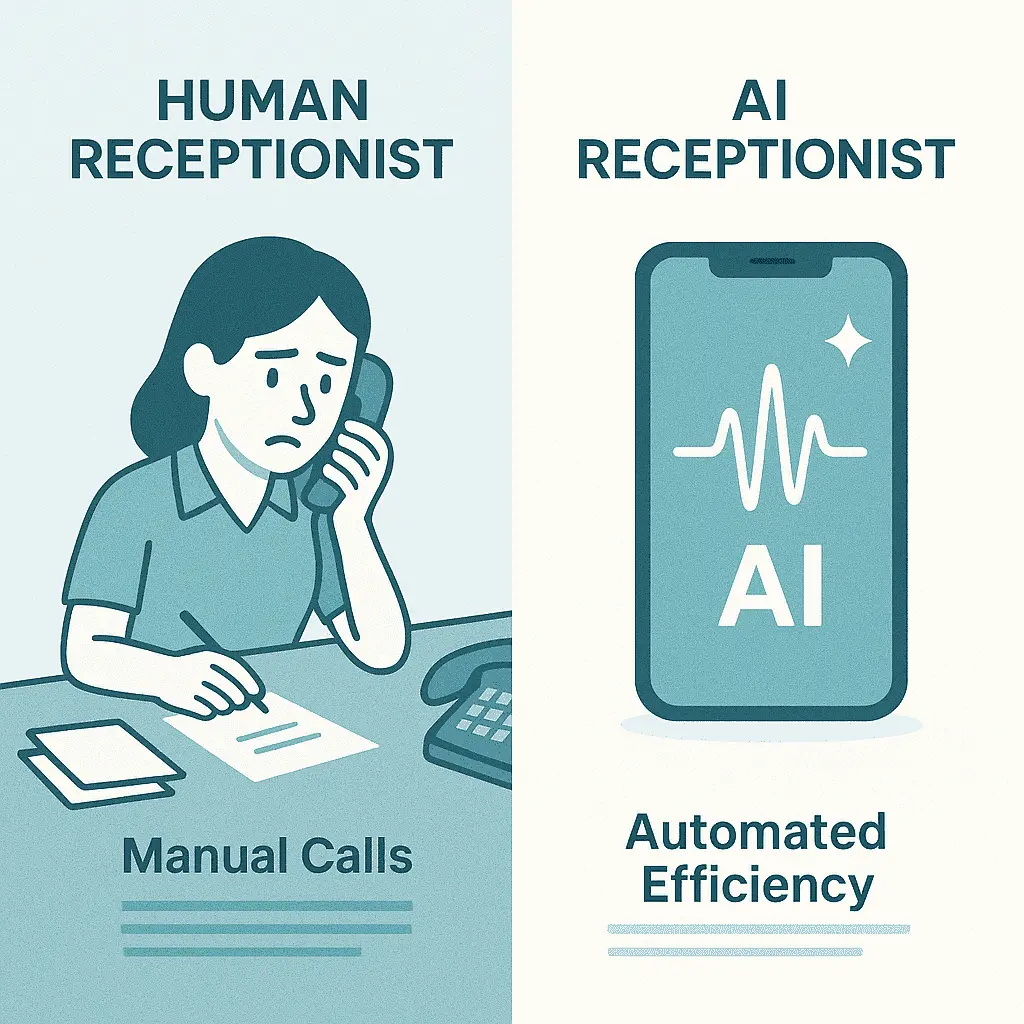
During the last 60 days, we rolled out our AI reception answering and calling service (https://receptionai.net/) across more than 20 beta practices. Development required 10 months of rigorous testing and problem-solving. Every challenging moment proved worthwhile given our final product. The results are remarkable—I’ll reveal the statistics shortly.
Yet I’ve observed remarkably strange choices during this rollout—stranger than almost any other practice management scenario I’ve encountered. Clear proof demonstrates that AI outperforms humans across nearly every measurable metric, yet curious reluctance persists.
It’s like I’m facing that anti-Wendy rebellion again, although now, the technology being fought costs merely $200 per week ($1-$1.79 per hour) compared with $100k-$200k-plus in yearly team salaries.
Why such pushback? This article explores possible answers. Hold tight.
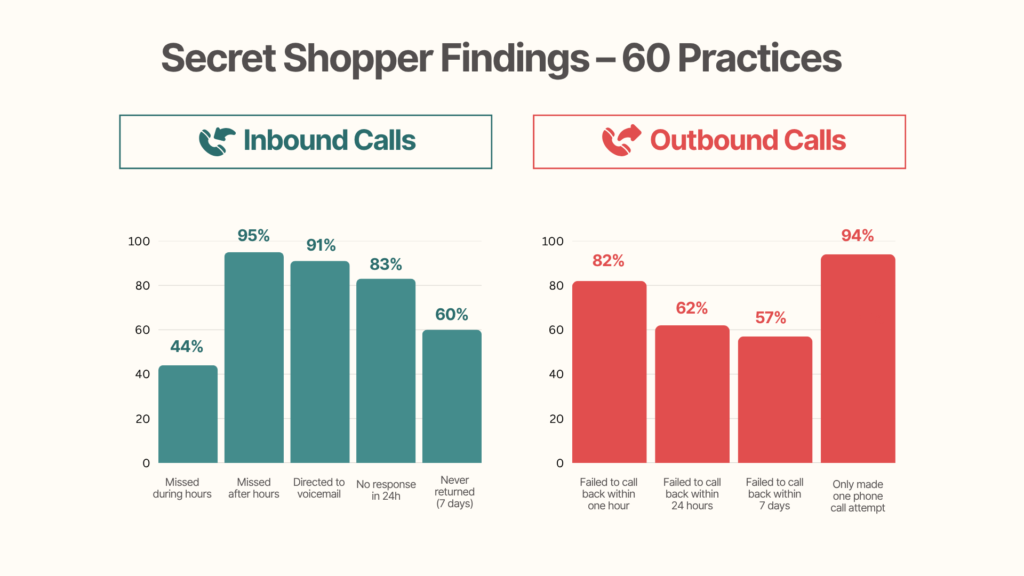
Let’s begin by diving into the findings from our covert shopper study spanning 60 practices. We enrolled in their lead generation programs, tracked response timing, then randomly phoned each location both during business hours and after hours.
Secret Shopper Discoveries:
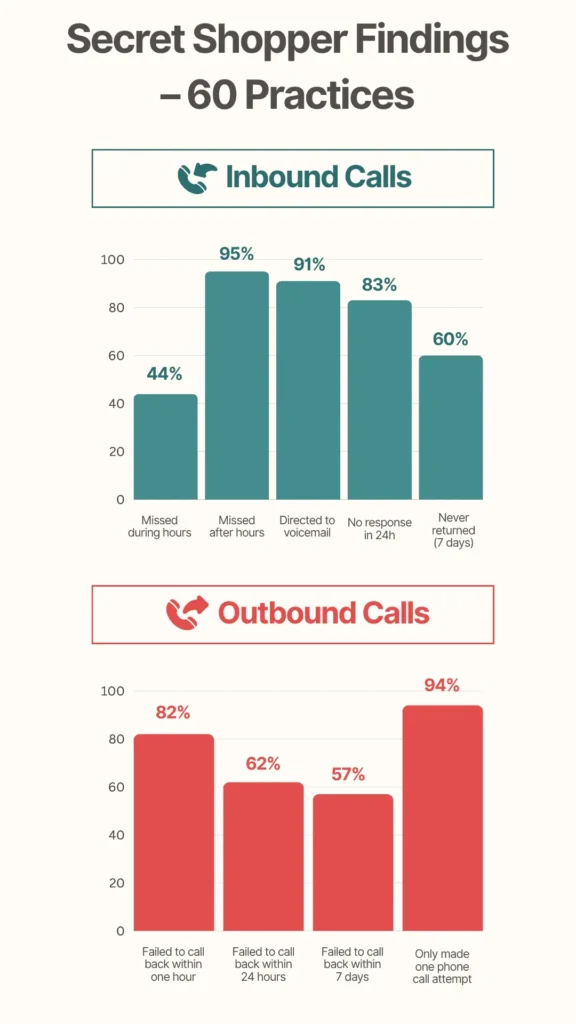
Inbound Calls (We Contacted Practices During and After Business Hours)
- 44% of phone calls went unanswered during business hours.
- 95% of after-hours and weekend calls went unanswered.
- 91% of unanswered calls were directed to voicemail.
- 83% of voicemail messages received no response within 24 hours.
- 60% of voicemails were never returned (tracked for seven days).
Outbound Calls (We Enrolled in Lead Gen Campaigns, Like Facebook Ads)
- 82% failed to return calls with one hour.
- 62% failed to return calls in 24 hours.
- 57% never returned calls after seven days.
- Among those who called back, 94% made only one attempt.
I conducted this study out of pure frustration. Client after client claimed they answered 90% of phone calls, had follow-up mastered, and booked 50% of leads. I couldn’t bluntly say they were full of, well … you know. But I knew one thing for certain: Either their team was lying or they were lying to themselves. With access to both digital marketing and EHR data across most practices, I saw reality: booking rates nowhere near their claims, and follow-up not happening in the reported timeframes.
Reporting these facts to them triggered Wendy-level skepticism. I needed hard evidence to demolish the “I book 50% myself” fantasy. The data were damning: 57% never followed up at all—not once in 7 days. Even when reading this, I’m certain that most think “not me”, and you would be dead wrong! Yes, you too!. Now contrast those dismal numbers with two actual ReceptionAI beta practices. Both implemented complete AI coverage for inbound and outbound during the past 60 days.
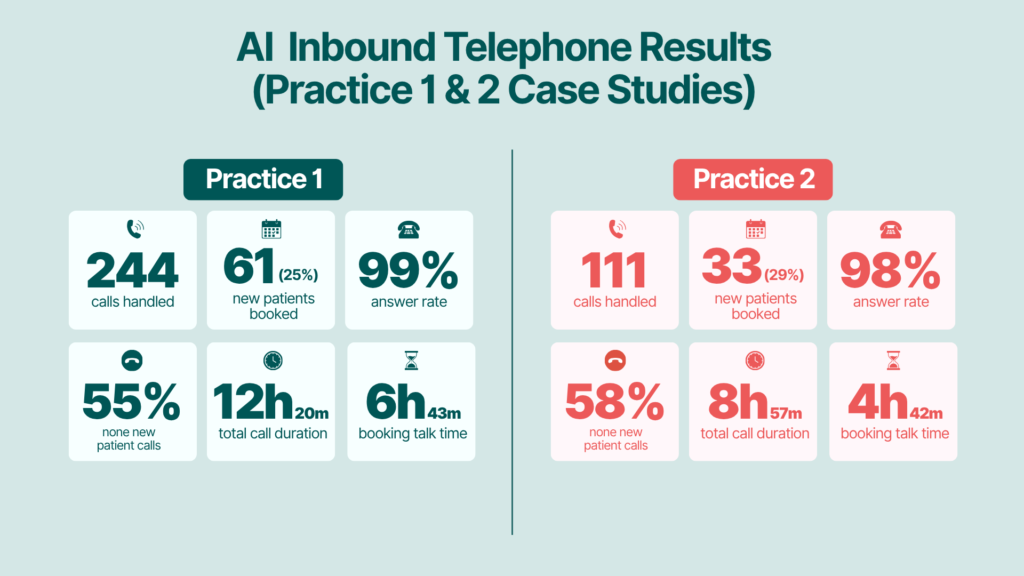
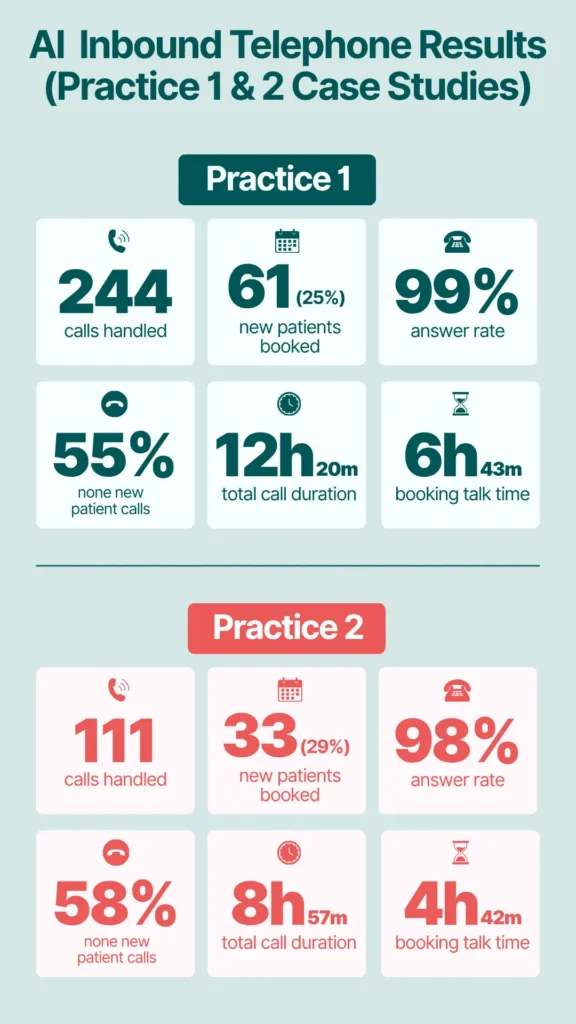
Inbound AI Telephone Performance Snapshot:
Note: With our launch group we initially recommend starting with after-hours and weekend coverage, although many practices launched 24/7. These results reflect stats when practices opted for 24/7 inbound answering.
- Answer percentage: 100% (lowest recorded: 97%)
- 54% of business-hour calls involve existing patients.
- AI takes messages and creates front desk tasks, acting as a concierge of sorts.
- 72% booking rate for new patient appointment requests through AI-answered phone calls
Outbound AI Telephone Performance Snapshot (Across 10,000 Calls):
- 98% of leads contacted within 60 seconds of submission
- 40-45% reach voicemail despite sub-60-second response times
- 35-45% book appointments when answering live (roughly one in two to one in three)
- 20-30% overall conversion from cold leads like Facebook campaigns (typically around 25%)
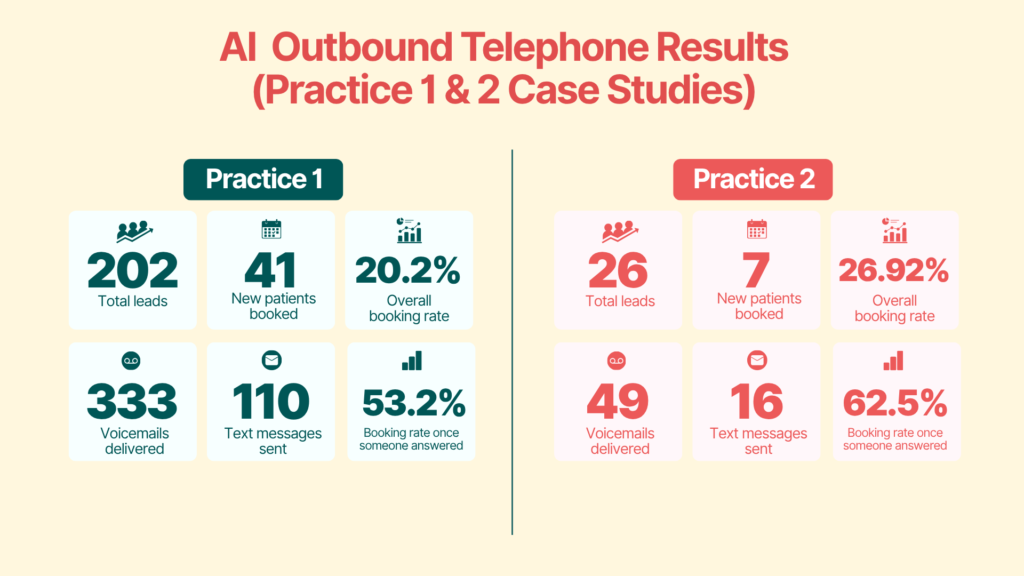
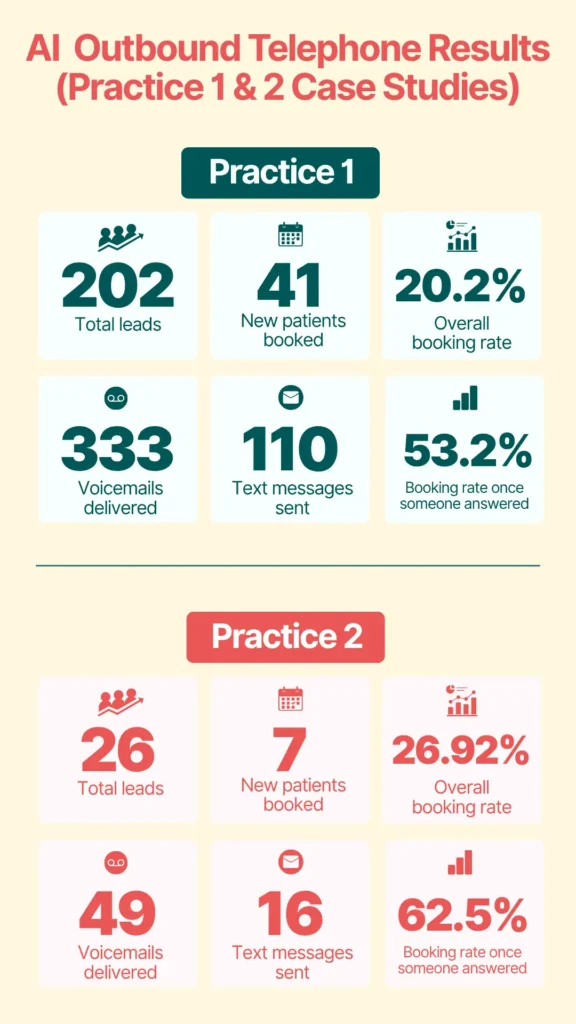
Practice 1
- Answer rate: 99% across all hours (business and after-hours)
- Total calls managed: 244
- Messages requiring follow-up: 55%
- New patients booked: 61
- Combined call duration: 12 hours 20 minutes
- Booking conversation time: 6 hours 43 minutes
- Average duration per call: 3 minutes
AI TELEPHONE OUTBOUND RESULTS:
- Total leads: 202
- Appointments booked: 41
- Overall rate of booking: 20.2%
- Attempts made: 646
- Contacted under 60 seconds: 97%
- Voicemails delivered: 333
- Text messages sent: 110
- Conversion when reached: 53.2%
- Combined talk time: 7 hours 22 minutes
- Total booking talk time with patients: 3 hours 15 minutes
Practice 2
- Answer rate: 98% across all hours (business and after-hours)
- Total calls handled: 111
- Messages requiring follow-up: 58%
- New patients booked: 33
- Combined call duration: 8 hours 57 minutes (front desk time saved)
- Booking conversation time: 4 hours 42 minutes
- Average duration per call: 8 minutes 54 seconds
- Total leads: 26
- Appointments booked: 7
- Overall booking rate: 26.92%
- Attempts made: 87
- Contacted under 60 seconds: 96%
- Voicemail rate: 42% unreachable
- Voicemails delivered: 59
- Text messages sent: 16
- Conversion when reached: 62.5%
- Combined talk time: 4 hours 42 minutes
- Booking conversation duration: 4 hours 42 minutes
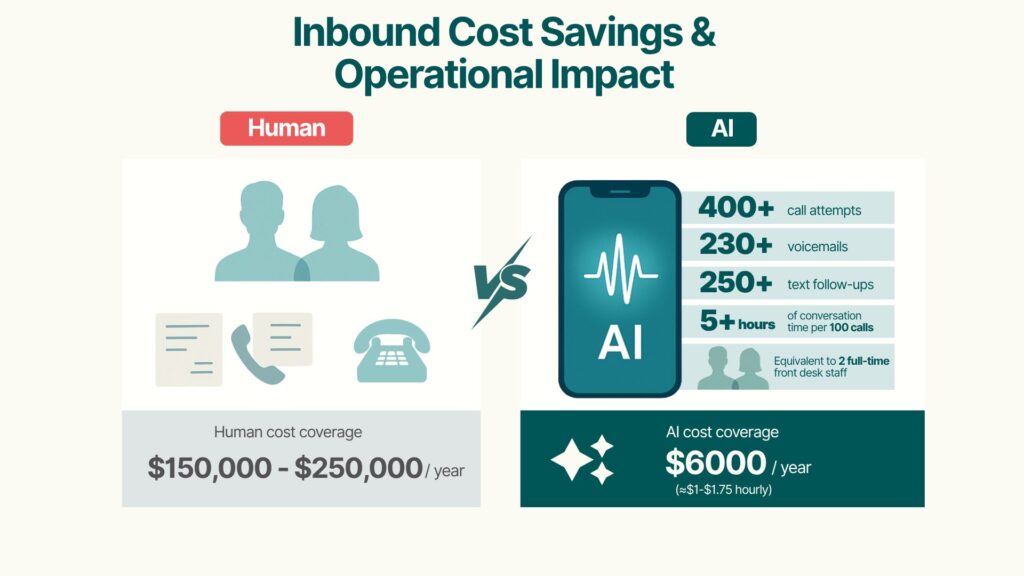
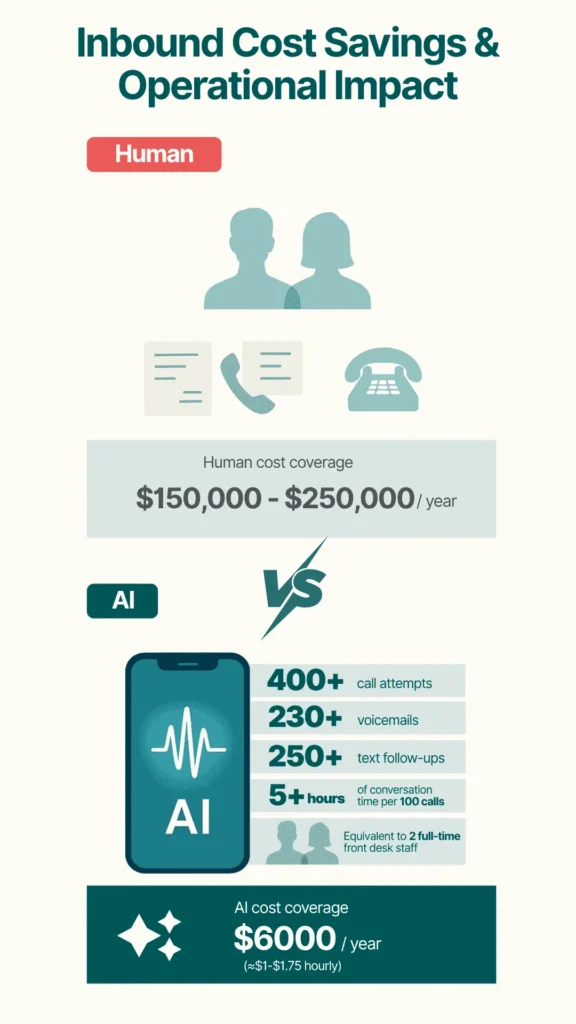
Inbound Cost Savings & Operational Impact
- Call cadence: Immediate contact, then twice daily for seven days
- 400+ attempts placed automatically
- 230+ voicemails delivered systematically
- 250+ texts and follow-up messages
- 5+ hours of conversation time
- Equivalent workload: Two front desk staff, full-time
- AI Cost Benchmark: $200 weekly ($1-$1.75 hourly) versus $150,000+ annually for human coverage
- 180 leads processed → 41 appointments secured (22.8%)
- 720 attempts completed
- 34.7% converted after live connection
- 9h 30m 50s combined talk time
- Weekly cost: $200
- Per 100 inbound calls, AI delivers:
- 99% answered within seconds—zero missed opportunities, no voicemail pile-up
- 6+ hours managed autonomously
- Average duration: 3-6 minutes each
- 55% categorized and assigned for clinic follow-up (existing patient inquiries)
Part II – Three Major Hesitation Areas
The “Weird” Objections: Despite Overwhelming Evidence
1. Voice anxiety: “The voice will turn people away”
Note: Pronunciation is weighted more highly than performance.
Counterintuitively, it seems that a perfectly pronounced non-booking is more valued than an imperfectly booked patient.
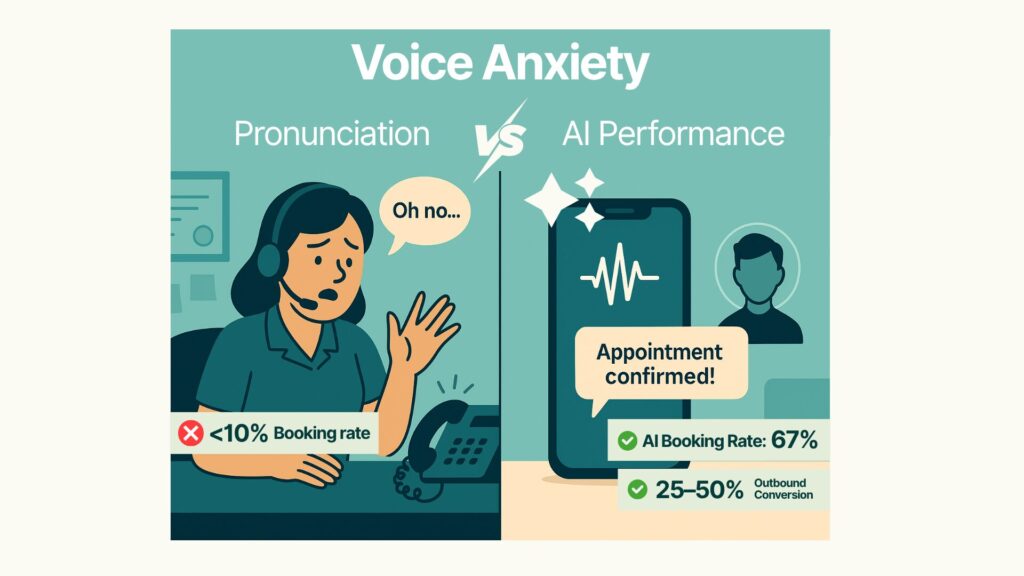
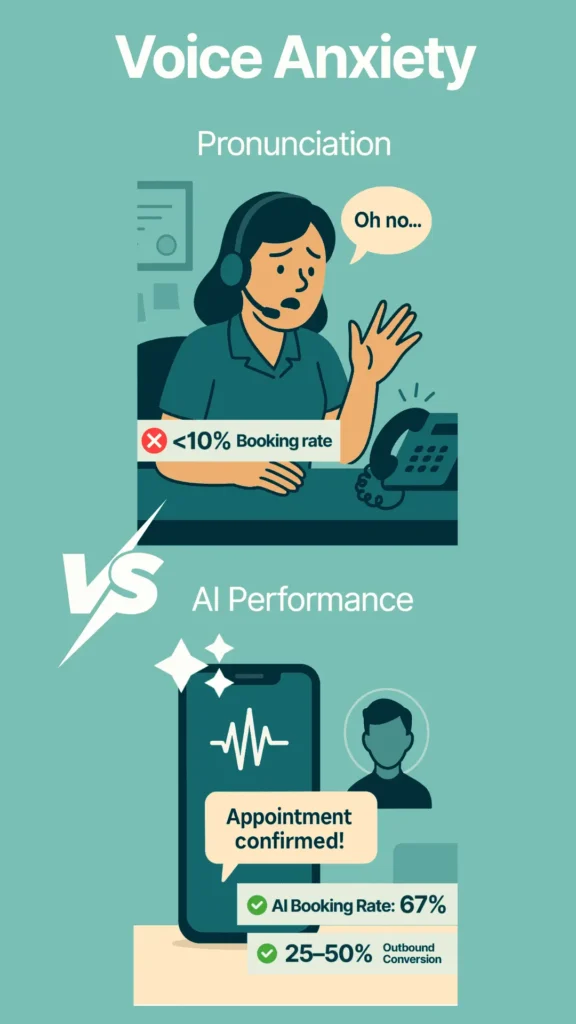
Real life Example – Voice Anxiety
Practice owner: “So cringeworthy. Is this thing really ‘ready’ yet?”
Our audit (performed the following day): Made 10 manual secret-shopper calls to their office → 0 picked up → 0 patients booked.
Food for Thought:
After nearly 12 months developing this product, the voice quality has improved exponentially. While it seems obvious that securing the booking is more important than having a CA who pronounces the surname correctly but never answers the call, the persistent question remains: “Will prospects detect they’re talking to AI?”
Several considerations before answering:
Does it matter? Within 6-12 months, I predict the conversation will shift to: “Unbelievable that in today’s AI-driven world, practices still can’t handle appointment booking at 8 p.m. Saturdays.”
Doesn’t the booked appointment matter more than minor pronunciation errors?
Wouldn’t humans equally struggle with such a complex surname?
Here’s the reality: imperfect bookings outperform perfectly articulated missed opportunities. AI NEVER ignores calls, and actual revenue should outweigh hypothetical claims about “superior human performance.”
Think about this scenario:
Suppose a receptionist independently answered a 9 p.m. call, successfully scheduled the appointment, BUT butchered the surname pronunciation. Grounds for dismissal? Obviously not.
And if that receptionist received $1-$1.50 hourly while delivering exceptional performance aside from one mispronounced word, would anyone deem her “substandard”? No way.
Somehow AI endures relentless scrutiny while humans escape judgment, despite delivering performance hundreds of percentiles inferior to the technology.
Another real life example
”Here’s another instance of my newly coined “pronunciation beats performance” bias. A customer began our consulting call with: “Not sure if AI is actually working here.”
I was naturally concerned since my team reported outstanding results. What had I missed?
After previously operating my own concierge scheduling service for chiropractors and knowing what top human-staffed booking companies deliver globally (frequently just 5%), her skepticism baffled me.
Eventually, after additional questioning, she confessed:
Their own booking percentages were below 10%.
Remember the context here: AI delivered verifiable 150% performance gains while providing 200%-plus in cost reductions. These numbers alone demonstrate that occasionally awkward phrasing doesn’t diminish results. Quite the contrary: all metrics improved significantly, plus the likely thousands of hours saved annually (I’ll circle back to that later).
Throughout these stories, “Wendy” and “AI voice agent” become nearly interchangeable. Both situations baffle me yet seem to originate from two immovable convictions: 1) my reception staff sounds better, even without hearing one actual call, and 2) my team would’ve answered that phone, despite statistics revealing that 44% of calls are missed during operating hours and 98% outside them.
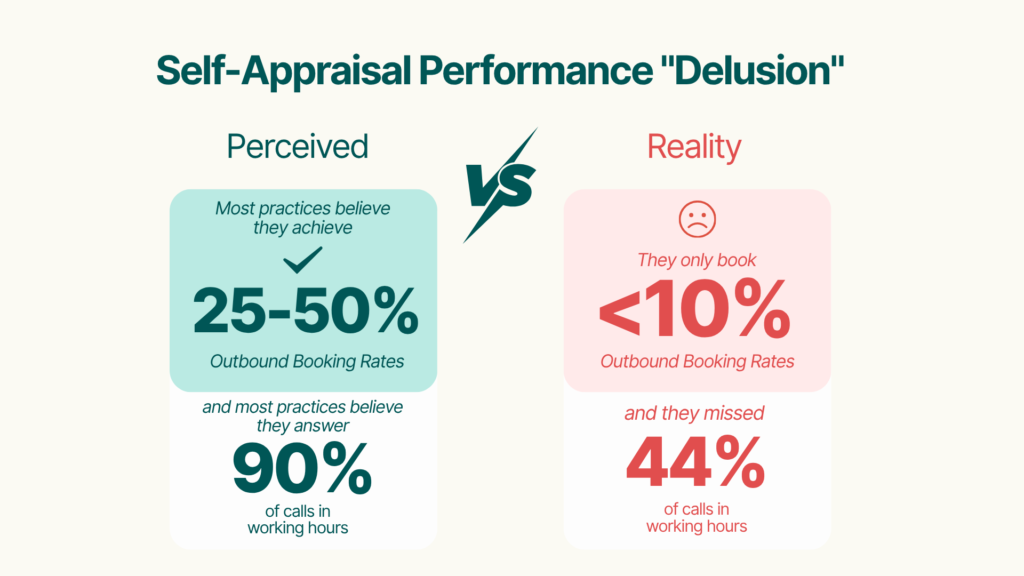
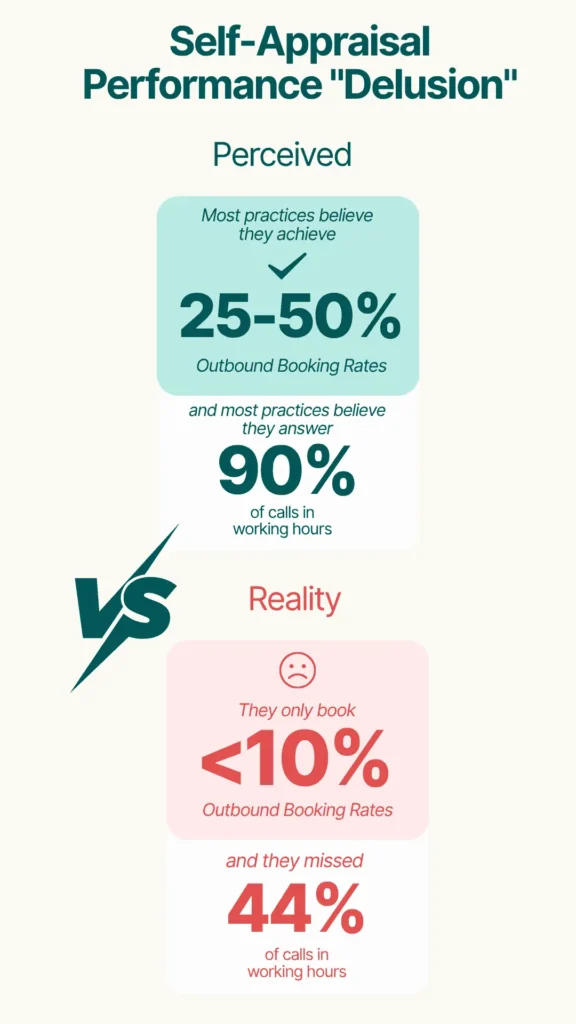
Self-appraisal performance delusion
What teams thinks
“Our team achieves 25% bookings and answers most incoming calls.”- 82% failed returning calls within one hour.
- 62% never called back in 24 hours.
- 57% hadn’t responded after seven days.
- Of the ones who called, 94% made just one attempt.
- 44% of calls went unanswered during business hours
- 95% of calls went unanswered after-hours and weekends
- 91% of unanswered calls were directed to voicemail
- 83% of voicemail messages received no response within 24 hours
- 60% of voicemails were never returned (tracked for seven days)
Time Savings Blindness
- Owner Response: Not convinced it actually saved us much time.
- Human hours required to “replicate” AI results (per 100 leads outbound, rounded figures, assuming near-perfect efficiency)
- Conversation time: 5.0 hours total
- Voicemail messages: 2.5 hours (230 messages × 0.6 minutes with rings & drop)
- Unanswered attempts (no voicemail): 1.0 hour (100-120 calls × 0.5 minutes with rings)
- Manual dialing & setup: 10-13 hours (400 attempts at 30-40 dials hourly)
- Text messages/follow-ups: 2.0 hours (250 messages × 0.5 minutes to craft/send/log)
- CRM updates & scheduling: 1.0 hour (400 entries × 0.15 minutes each)
- Subtotal: 22-25 hours
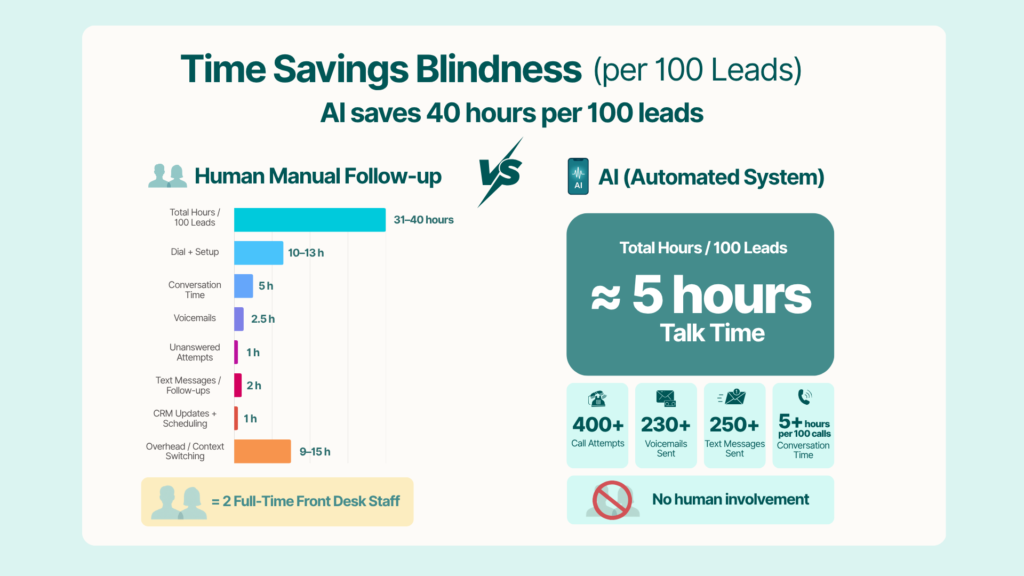
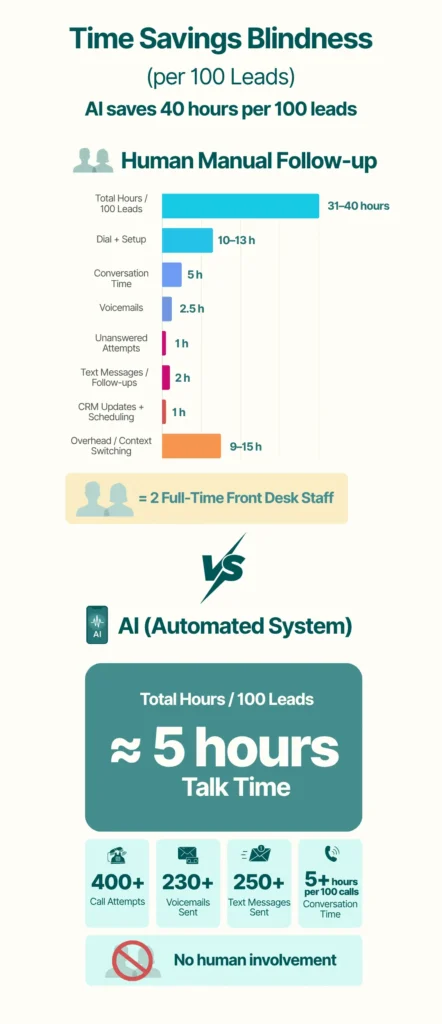
Actual overhead (breaks, context changes, transitions, meetings, mistakes/corrections): +40-60% → 9-15 additional hours for 100 leads
Final time: 31-40 hours for 100 leads
- Total calls: 111, mixture of new patient bookings, rescheduling requests, plus other general patient inquiries
- New bookings: 33
- Talk duration: 7 hours 34 minutes
- Average per booking: 8 min 54 sec
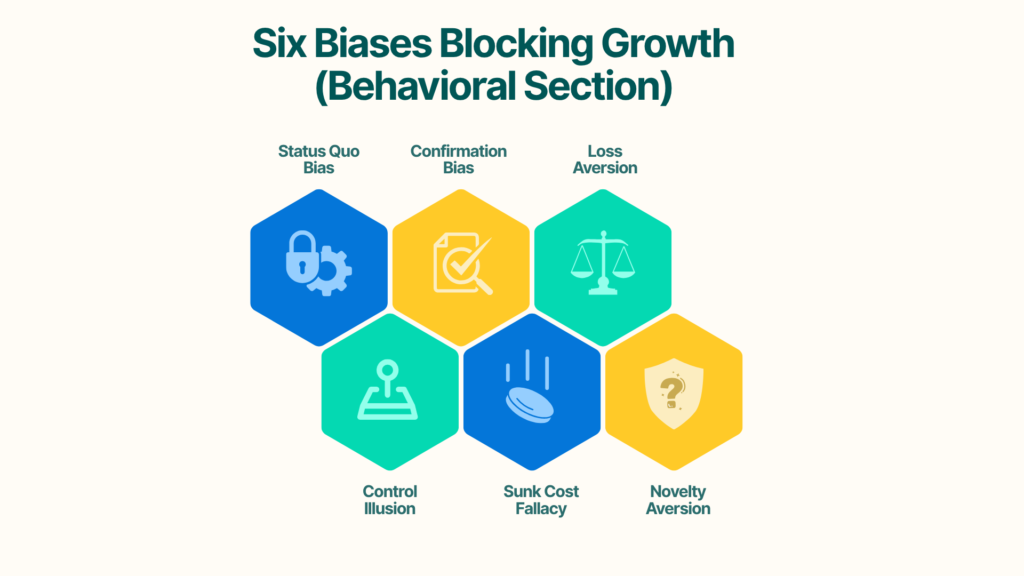
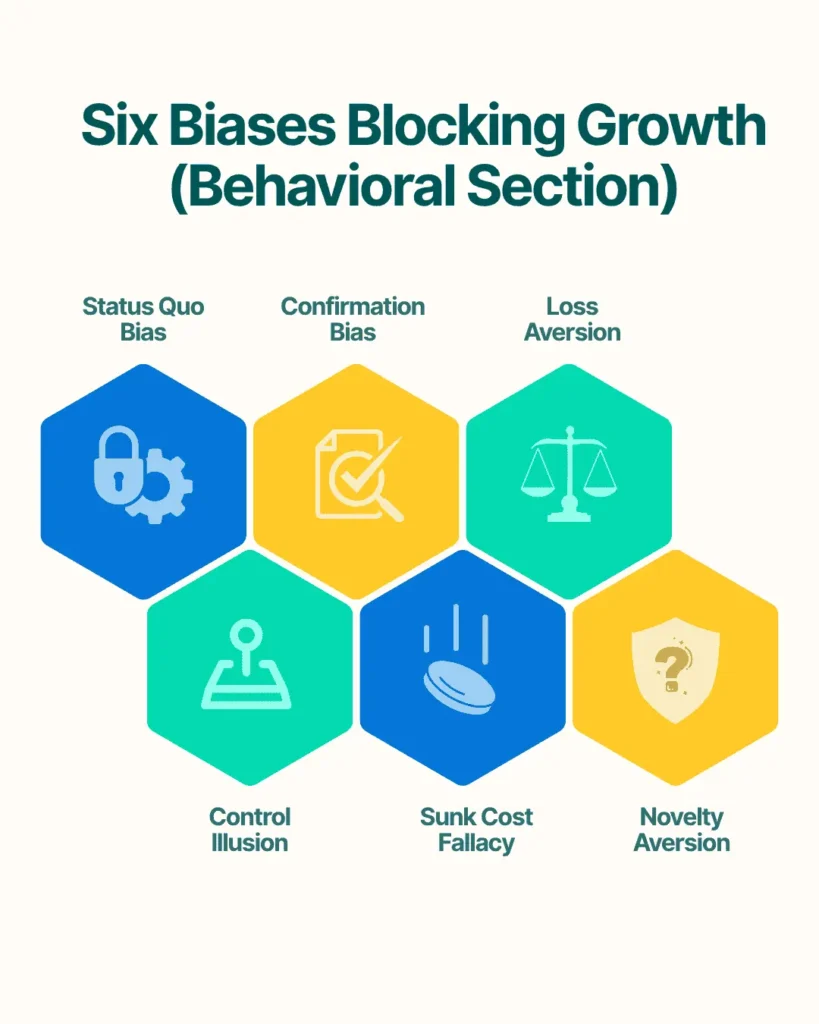
Back Part III: Six Biases Blocking Chiropractic Growth
When practice owners encounter data-backed evidence showing AI systems generating 100-400% improvements yet still hesitate or resist implementation, they’re not responding purely rationally. They’re reacting through several overlapping psychological biases.
Definition: The tendency to prefer things to stay the same, even when change offers clear advantages.Preferring things remaining unchanged, even when transformation offers obvious benefits. Application: Many chiropractors achieved success via human connections—receptionists, CAs, manual processes—so substituting that with ‘machines’ feels like betraying what worked. Emotionally, preserving existing workflows feels safer, despite contradictory evidence.
Definition: Pursuing information validating current beliefs while rejecting contradictory evidence.
Application: When practice owners believe “humans build better rapport” or “AI lacks empathy,” they subconsciously dismiss outlier successes as anomalies. Despite viewing comprehensive performance metrics, they fixate on possible drawbacks (“What if it sounds unnatural?”).